Most patients who come to me for rhinoplasty consultation have already spent a long time thinking about it. They know what bothers them. They have their concerns ready. What I often find, though, is that what they think they want and what will actually look good on their face are sometimes different things — and that conversation, that gap, is exactly what a proper rhinoplasty consultation is designed to close.
Rhinoplasty is not simply about making the nose smaller. It is about creating balance between facial features. And balance is much more nuanced than most social media filters would have you believe.
What Rhinoplasty Actually Is
Rhinoplasty is a surgical procedure that modifies the shape, structure, or function of the nose. Some patients come to me for cosmetic reasons — they dislike the dorsal hump, the tip shape, the width, or the overall proportions. Others also have breathing concerns, previous trauma, or asymmetry that developed over time.
Every nose is different. Every face is different. When I evaluate a patient, I am not only looking at the nose — I am looking at the entire face. I think about:
The goal is not to erase identity. The goal is refinement — a nose that looks like it belongs on your face, because it does.
“I can improve your nose significantly. I cannot give you someone else's nose. What we are building toward is a version of your nose that fits your face better — not a replacement.”— Dr. Karamat Ullah Miami
Why Natural Rhinoplasty Matters
One of the biggest mistakes I see in rhinoplasty planning — and I see this in consultations where patients have already had surgery elsewhere — is focusing only on making the nose smaller. Smaller is not always better. A nose that looks attractive in a photo can look completely wrong in real life if it does not suit the rest of the face.
Natural rhinoplasty often means preserving things. Preserving facial character. Maintaining healthy structure. Respecting the relationship between the tip, the bridge, and the base. Avoiding over-rotation that looks artificial. Creating smoother transitions rather than dramatic changes.
When a patient tells me, “I want improvement, but I still want to look like myself,” that is usually the correct mindset. And it is a mindset I can work with effectively.
What Patients Come to Me For
In Peshawar, I see a wide range of rhinoplasty concerns. Some are structural, some are cosmetic, some are a combination. The most common concerns patients discuss with me include:
No two consultations are the same, even when the concerns sound similar on paper. Anatomy is the determining factor, and anatomy varies significantly from patient to patient.
From My Consultation Room
What I actually look at during consultation
Before I discuss anything surgical, I look at the entire face — forehead height, chin projection, lip position, and how the nose sits in relation to everything else. The nose is never evaluated in isolation. That context changes everything about what I would recommend.
Why skin thickness matters more than most patients expect
Thick skin hides fine refinements. Thin skin shows every imperfection. Two patients with identical requests may need completely different surgical approaches because of this alone. I explain this clearly at every consultation because it shapes realistic expectations.
The most honest thing I tell rhinoplasty patients
I tell patients: I can improve your nose significantly. I cannot give you someone else's nose. What we are building toward is a version of your nose that fits your face better — not a replacement. That mindset usually leads to the best outcomes.
Why I avoid copying celebrity noses
A nose that looks perfect on one face can look strange on another. Facial proportions, bone structure, ethnic identity, and skin all influence what works. I have seen patients arrive with a photo of a nose they want, and I have to explain why that exact shape would not suit them. It is not a disappointing conversation — it is an important one.
Understanding Rhinoplasty Recovery
Recovery is one of the parts of rhinoplasty that patients most underestimate. Not because it is extremely difficult, but because it takes much longer than most people expect. I am very direct about this in every consultation.
First Week
Days 1–7- Swelling and bruising are expected and normal — do not be alarmed
- Nasal congestion is common and will pass
- A splint may be in place depending on the technique used
- Rest and following aftercare instructions carefully is essential
Two to Four Weeks
Early improvement- Early swelling begins improving gradually
- Bruising usually fades significantly by the end of this period
- Most patients begin feeling more comfortable socially
- The nose still looks swollen to you — this is completely normal
Three to Six Months
Continued refinement- Nasal definition gradually improves as swelling resolves
- Many patients feel genuinely pleased with progress at this stage
- Tip swelling may still persist, especially with thicker skin
- This is not your final result — continue being patient
Up to One Year
Final maturation- The nose continues to refine and settle throughout this period
- Tip definition often improves most noticeably in the later months
- This is when final results become clear
- Patients with thicker skin may see changes even beyond twelve months
I always tell patients: the nose you see at six weeks is not your final nose. Judging too early leads to unnecessary anxiety. Trust the process, follow your aftercare, and let healing happen at its own pace.
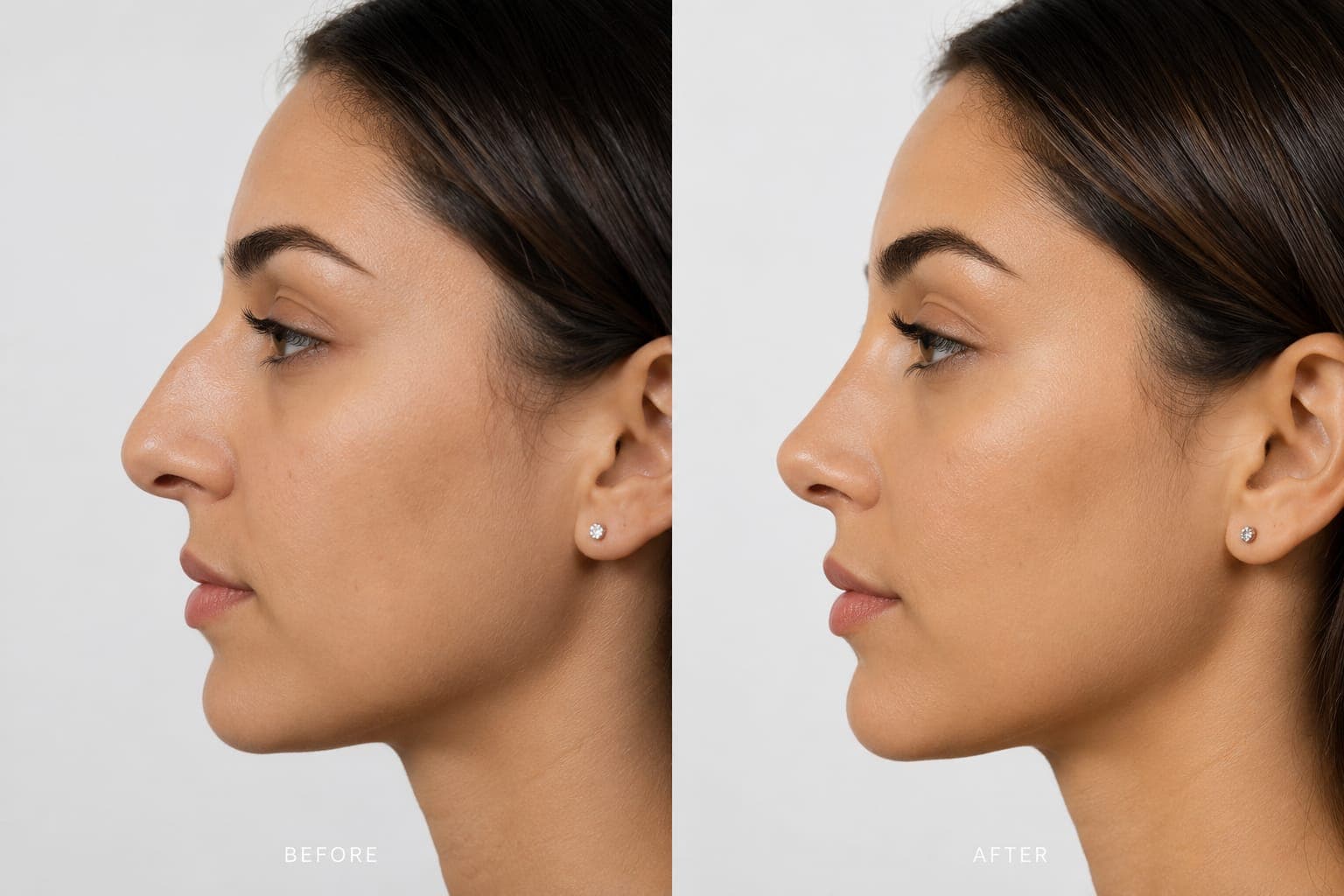
Natural Balance
Refinement that preserves facial character
Can Rhinoplasty Also Improve Breathing?
This question comes up often, and the honest answer is: sometimes, yes — but it depends on what is causing the breathing issue. Some patients have a deviated septum. Others have internal narrowing, collapsed internal valves, or structural changes from previous trauma. Each of these requires a different evaluation.
Not every cosmetic rhinoplasty also addresses breathing. And not every breathing problem requires cosmetic rhinoplasty. I assess both independently and combine the planning where it makes sense for the individual patient.
My approach
A nose should not only look balanced — it should function well. When a patient presents with both cosmetic and functional concerns, I evaluate them together and discuss what can realistically be addressed in a single procedure versus what may need separate planning.
“Natural results come from understanding what each patient actually needs — not from following a trend or copying a template.”— Dr. Karamat Ullah Miami
For International Patients Considering Rhinoplasty in Pakistan
I see patients from across Pakistan and from overseas — the USA, UK, UAE, Canada, and Europe. For patients travelling from abroad, the process usually begins online through WhatsApp, where I ask for:
- Front-facing photos and side profile photos
- A brief description of what bothers them
- Medical history, any previous nasal surgery
- Questions they want to discuss
I always encourage patients to avoid rushing this decision based solely on online content. A good rhinoplasty requires proper face-to-face evaluation, honest discussion, and realistic planning. That cannot be replaced by a filter or a social media transformation.
Safety and What I Tell Every Patient Before Surgery
Rhinoplasty should not be approached casually. Before any procedure, I want to know that a patient understands what is realistic, understands the recovery commitment, and has thought carefully about their motivations.
No surgeon can ethically guarantee perfection or an identical result to another person's nose.
Healing is individual — two patients with identical procedures may heal differently.
The decision should come from a stable, informed place — not from a bad photo or a difficult period.
When all of those things are in place — proper evaluation, realistic goals, honest discussion — rhinoplasty can make a meaningful and lasting difference.
— Dr. Karamat Ullah Miami, Miami Plastic Surgery & Hair Transplant Center, Peshawar